Showing posts with label The V. Show all posts

Wednesday, May 25, 2011

Saint

Editorial of The Varsitarian, May 16, 2011.


BLESSED POPE JOHN PAUL II IN UST. Portrait depicts the late Pope’s 1995 visit to Asia’s only Pontifical University, and the fondness and affection of the Filipino people toward him. Illustration by PATRICK C. DE LOS REYES.TENS of thousands of Catholics from all over the world flocked at St. Peter’s Square to witness and rejoice in the beatification of Pope John Paul II last May 1, a showcase of the people’s love and appreciation for the Supreme Pontiff who led the Church for 26 years until his death in 2005. Tens of millions more did the witnessing and rejoicing through the electronic media if not vicariously, at least spiritually. And they weren’t all Catholics. They were people from other denominations and other religions who did not hide the affection and high regard they hold for the new beato.
To the Roman Catholic Church and beyond, the Blessed John Paul II was an example of sheer faith, and love amid strife and the many adversities of life. His successor, Benedict XVI, called him “an immense grace which embraced Rome and the whole world: a grace which was in some way the fruit of my beloved predecessor’s entire life, and especially of his witness in suffering.”
The miracle that qualified the late Pope for beatification was the healing of a similar suffering in Sister Marie Simon-Pierre, a nun who asked for his intercession when Parkinson’s disease was already getting in the way of her duties as a faithful.
The man of humble and tragic beginnings was born Karol Jozef Wojtyla in Wadowice, Poland in 1920. At a young age, he faced many loses with “death hovering over the family”—an infant daughter had died before his birth, his mother Emilia passed away a month before he turned nine years old, and his brother Edmund followed three years later. In the midst of the Nazi occupation in 1941, his father Karol had a heart attack and died, leaving the younger Karol completely orphaned.
“At twenty, I had already lost all the people I loved, and even those I might have loved,” the Pope would say in an interview nearly forty years later.
But the man turned to his faith and the Church, even when he was fully capable of taking on other paths given his intellectual talents and charm. His ordination as priest when he was 26 years old would be the start of his swift and surprising climb up the Church’s hierarchy, becoming one of the youngest cardinals in 1967.
The biggest surprise would come on October 16, 1978, when the Sacred College of Cardinals elected him as the 264th pontiff and the first non-Italian one in more than 400 years—a role that he reportedly accepted “before the cardinals with tears in his eyes.”
Speaking on the balcony overlooking the crowd that patiently waited, the reluctant new Pope said that he received the event “in the spirit of obedience to Our Lord and in the total confidence in his Mother, the most holy Madonna.”
From then on, he would be known as John Paul II and would spend the rest of his life with an even bigger family and more responsibilities. As head of one of the biggest sectors of faith in the world, the Supreme Pontiff embraced his newfound kin by traveling to be with them—making him “one of the most-travelled world leaders in history,” reaching more than a hundred countries and visiting the Philippines twice.
His pilgrimages, however, went beyond the Catholic circle. A peacemaker whose charm and sincerity seeped through negotiations, the Pope had touched the hearts and reestablished links with other religious groups like Judaism and Islam. He also met with many political leaders, appealing for peace and better relations.
He would be known by many names and advocacies, one of which is his love and encouragement for the youth. It was in 1985 when he initiated the first World Youth Day (WYD) and it has been held and anticipated since.
His second and last sojourn to the Philippines was for the 1995 World Youth Day in Manila, with its closing Mass at Luneta considered to be the largest Catholic gathering in history. During this visit, the Pope also visited again the University of Santo Tomas, which was hosting the International Youth Forum, the Catholic youth leaders’ forum of WYD. The Pope’s address before the mammoth crowd at the UST Grandstand put in proper perspective while UST enjoys special papal regard historically: “As a pontifical university, Santo Tomás has a special right to the Pope’s attention,” the Pope said. “In fact, this is the third visit of a Pope to the oldest university in Asia: Pope Paul VI came here in 1970; I came in 1981 and now God gives me the grace of being here again to meet the ‘university world’ of the Philippines.” Blessed John Paul added: “As a former university student and professor myself, I feel a special affinity with you. I wish to encourage you to live the University experience with dedication and commitment, in the pursuit of human and academic excellence, with a great sense of responsibility toward your families and society, toward your future and the future of your country.” Years later, when Philippine bishops and clergy visited him in Rome and reminded him about UST and Filipino Catholics, the Pope said he remembered those days “very well [because of] how warmly you received me during the World Youth Day.”
John Paul II dedicated himself to the service of God and the Church amid his long, hard struggle with Parkinson’s disease and the many controversies that he faced during his pontificate. But much like his fond remembrance of the University, John Paul II’s papacy is still regarded not for its shortfalls but its achievements.
Now, only six years after his passing, he has been beatified, which formally declares him among the elect in heaven and worthy of veneration. Even beyond his earthly life, the well-loved Pope is showing us that little miracles can lie in what we decide “to do with the time that is given us.”

Sinner
On the other side of the spectrum is another—but different—kind of remembrance.
Sen. Ferdinand “Bongbong” Marcos Jr., the only son and namesake of the late president Ferdinand Marcos, has revived the clamor to bury his father’s remains in the Libingan ng mga Bayani—the “hallowed place reserved for heroes,” including former presidents and government dignitaries, Filipino veterans, national artists, and military personnel who died in the line of duty.
The issue, which has been dragging on for decades, has dug up old wounds once again. President Benigno Aquino III, whose father was allegedly killed upon the older Marcos’ orders, may have opened his heart to co-existing with the Marcoses peacefully, but he was not ready to take on this huge decision and tossed it over to Vice President Jejomar Binay to prevent his bias from getting in the way.
The plea would bellow in many sectors, even in Congress, where a resolution was signed by more than 200 congressmen, “urging [Aquino] to allow the burial of Marcos at the Libingan.”
The survey outfit Social Weather Stations found that Filipinos have a “virtually exact split opinion” on the matter after their March 4-7 survey, while the StratPOLLS Inc. saw that 71.6 percent—or seven out of 10—of 250 residents in Metro Manila favor the controversial burial.
Marcos’ remains are in a refrigerated crypt in an “ill-maintained and dilapidated” mausoleum in Batac, Ilocos Norte. Marcos kin and supporters keep on citing how his mausoleum is unfit for a former president. But it was the megalomania of the Marcos family and supporters that set up the ghastly mausoleum in the first place. As far as the requirements of Christian charity and human respect are concerned, the former strongman had been accorded that when, after dying in Hawaii where he had fled during the Edsa revolution of 1986, his remains were allowed to be brought home. Many countries that have kicked out dictators haven’t allowed their remains to be brought home.
A Catholic country, the Philippines has rewritten the rules on ousted despots and presidents in the interest of charity. But the Marcos family and their minions still insist on burying him at the Libingan because his mausoleum is “dilapidated” and apparently cannot be properly maintained by the billions he had plundered. Apparently the snootiness of his family and followers cannot be backstopped by the billions they had pillaged: since they cannot put their money where their mouth is, they want the people to foot the bill for their superciliousness. Despite the mercy accorded the strongman, his family, and cohorts by the people who allowed them to come home in the first place, they still want to push the envelope; they’re merciless and irredeemable.
It’s an insult to the Edsa revolution and the tens of thousands of human rights abuses under Marcos, as well as those who have worked for the restoration and the nurturance of our democracy that the Marcoses and their sycophants could demand state burial for the ousted despot. It’s an insult to the many men and women—journalists, politicians, and civilians alike—whose rights and lives were put to disdain by the stronghold of the dictator, his thugs, and his kleptocrats.
That the Marcos kin and minions have had the gall to demand a state burial for the strongman—and the fact that the public at large seems willing to go along with them—should indicate that the battle for historical memory is slipping. More and more, Filipinos feel a little kinder toward Marcos not really because his successors haven’t been any better (although that’s part of the reason), but because Filipinos continue to be infected by short memory and shallow thinking: they can’t seem to understand that many of the ills affecting the nation now owes to martial law and Marcos’ scornful decision in 1972 to destroy the rules of the democratic game so as to perpetuate himself in power by corrupting the military and the body politic. The Filipino people should not disgrace themselves further: they should say No to burying Marcos at the Libingan and say Yes to charity with, above all, truth and justice.

Friday, May 20, 2011

RH bill: Spawn of statism

Editorial of The Varsitarian, April 13, 2011


A DIFFERENT show of people-power was staged last March 25 at the Quirino Grandstand when the clergy and religious, pro-life groups, and the Church as a whole gathered to call for the abolition of the Reproductive Health (RH) bill.
During the Mass, attended by some 200,000 to 300,000 people, Manila Archbishop Gaudencio Cardinal Rosales called for respect for life and the junking of the RH bill. Cardinal Rosales said that despite the bill’s avowals of “responsible parenthood” and “sexual responsibility,” its bias for contraception and “safe sex” is very evident, so that it is hardly expected to foster authentic responsibility and discipline, two virtues, he said, that the people and the nation need. He added that people’s indifference to life, if not their utter disrespect of it, could lead to moral decay.
The Cardinal said life should be defended from conception: “Kapag hindi pinahalagahan ang buhay na iyan sa alinman o saan mang yugto ng buhay ng tao, (sanggol, fetus, matanda, malakas, o mahina) hinding-hindi igagalang ang buhay ng sinuman—at diyan kapag wala ng halaga o walang pagpapahalaga, wala ng magtatanggol sa buhay.”
The Cardinal’s remarks are a re-expression of what the Varsitarian has said in its last editorial (“RH Bill: Deadly, Anti-Constitution”). Despite its claim to being a lawful measure by its invocation of supposed constitutional principles and state policies, the RH bill is mum on the most important constitutional principle and state policy that should apply on any measure that seeks to regulate births, curb population growth, and introduce sex education—that the “State recognizes the sanctity of family life and shall protect and strengthen the family as a basic autonomous social institution. It shall equally protect the life of the mother and the life of the unborn from conception. The natural and primary right and duty of parents in the rearing of the youth for civic efficiency and the development of moral character shall receive the support of the Government.” (Section 12, Article 2) If one pits all of the questionable provisions of the bill against this proviso, one will recognize how the bill is in fact an attack on the 1987 Constitution that had been overwhelmingly ratified by nearly 80 percent of the population! One will agree with the Varsitarian that it is “deadly,” “anti-life,” “anti-family,” and “anti-constitution.” One will recognize that the RH bill is an attack on human dignity and the Filipino nation!
Oh, but contraception is not abortion, the RH bill proponents maintain. But only the truly dense cannot see through their smokescreen, their lie. In the first place, the bill makes a blanket approbation of all contraceptives, which it wants to be declared as “essential” medicines. Some of these contraceptives are technically abortifacients, even physicians admit that. Moreover, the bill compels medical workers to provide services to women suffering post-abortion complications, which is a condonation of abortion and violates the penal statutes on the crime. Much as mercy and compassion should be extended to women suffering from complications arising out of abortion, wouldn’t a law that forces medical practitioners to extend services to them, regardless of established ethical medical protocols, encourage other women to commit abortion, which is a criminal act? In short, doesn’t the RH bill in fact abet criminality?
Meanwhile, UST, maintaining its Catholic nature and character, released a statement last March 24 opposing the RH bill, saying it violates conscience and tramples upon religious freedom.” It said that any government-sponsored responsible parenthood program should be motivated by an “option for life and not against it. Backing the Catholic Bishops’ Conference of the Philippines’ stand, UST said natural family planning was the better option as it is “not only pro-life but also pro-poor and pro-women, since it does not endanger people’s health.”
UST is specifically opposing provisions in the consolidated RH bill or House Bill No. 4244, such as Section 9 which names contraceptives as essential medicines, Section 18 demanding all employers to include contraceptives in their employee’s economic package, and Section 22 that prohibits any person from “malicious engagement in disinformation about the intent or provision of this act.”
“This would mean that the purchase of contraceptives shall be the burden of all tax-paying Filipinos, even those who, in conscience, are pro-life,” UST said in its statement. “This is a violation of the freedom of religion, of freedom of conscience, and of freedom of expression.”
As much as how the mainstream media generally biased for the RH bill portray the rally and UST’s stand, both events evinced a growing awareness in the Church and society at large of the demonic ends of the bill, its utter disregard of life. Despite secularism and the pro-choice mentality of many Filipinos, it’s good to know that there are still Catholics and other Filipinos who belive in the sanctity of life and the right to life of both the born and the unborn.
Moreover, Filipinos are beginning to see the dark social-engineering dimensions of the bill. Contrary to what the authors of the bill have been trumpeting, the RH bill is not pro-poor. If it is, then there will be no need for the more than a billion of pesos that is planned to be spent during its initial phase. Filipinos are beginning to realize that the money for it would be better used to address directly the education, food and health needs of the poor. After all, the poor need food, clothing and shelter, not condoms and contaceptives. Filipinos are beginning to see that the RH bill authors and supporters are really Stalinist legislators who see the poor as sex-starved rabbits and blame the poor for their poverty.
In fact, family planning and population control were enshrined in the Marcos Constitution of 1973. Despite the widespread implementation of the draconian birth control law, poverty persisted, denying any correlation between population and poverty. On the contrary, the Philippine economy collapsed, which should show that poverty is caused, not by overpopulation (no such thing), but by corruption, mismanagement, and monopolistic and oligopolistic practices.
Now, Congress, backed by academics from the University of the Philippines (self-proclaimed leftist and nationalist) and Ateneo de Manila University (self-proclaimed democratic liberal and nationalist), both elitist and bourgeois institutions, want population control back! Their concourse should show that Statism exists, whether in the left or the right, and that Stalinists and fascists aren’t so strange bedfellows. In fact, for all practical purposes they’re cozy intimates. And from their act of consummation would issue the monstrous offspring—the RH bill, nothing less than the spawn of Statism.

Saturday, March 19, 2011

New RH bill: Deadly, anti-constitution

From the Editorial of "The Varsitarian" dated March 15, 2011

PRESIDENT Aquino III should be commended for dropping the reproductive health (RH) bill from his legislative agenda. But his minions in the House of Representatives just the same are prioritizing the passage of the bill. They have in fact consolidated several versions of the bill and rammed it through the process so that, despite the denial of House Speaker Feliciano Belmonte that they were rushing the bill, it’s now on its second reading and up for plenary debates. What the right hand giveth, the left taketh.
The consolidated version incorporates the President’s version of family planning, “responsible parenthood,” and further pushing the envelope, now uses the word “population,” making Edcel Lagman and his battened likes eat their word since they had been claiming before that heir original version of the bill was not a population-control measure. Considering that just about every shade and nuance of the population-control movement has been incorporated into the consolidated version, the bill is now known as “The Responsible Parenthood, Reproductive Health and Population and Development Act of 2011.”
With 35 sections and more than 5,800 words, the bill promises to become the most extensive measure by any Congress in history, and should leave no doubt to anyone about its Stalinist conceit and social-engineering intentions. Just about every possibility of unwanted pregnancy and regeneration by the poor is checked by the bill. While ostensibly declaring it does not set “demographic and population targets,” it declares that the ideal family size is two, which is just about saying that the population growth target should be zero. (The ideal population growth for the Philippines is zero, according to RH backer and former health secretary Alberto Romualdez!) The bill adds that the state “shall assist couples” to achieve that size.
Those who say that there’s nothing wrong with this should be reminded that the state is not exactly wet behind the ears: it is after all the state and its bureaucracy that have fostered the corruption and waste that characterize the debacle that is the Filipino republic. Considering the sorry tale of the tape as far as the Philippine state is concerned, should the state, which has an overpopulation of bureaucrats battening themselves like Lagman and congressmen on people’s money, have the right to suggest, much less, declare that there’s such a thing as an “ideal” number of children for couples to have?
Much more, should the state have any right to add what follows after the bill’s arrogant discourtesy of declaring how many children Filipino couples should have: “Attaining the ideal family size is neither mandatory nor compulsory. No punitive action shall be imposed on parents having more than two children.” One should rightly cringe at that.
“Assisting” couples to attain the ideal family size wouldn’t be hard for the state since the bill sanctions just about any contraceptive means and, making free use of taxpayer’s money and funding from foreign donors that support abortion, makes them available to all. Those who argue that the bill is pro-choice but not necessarily pro-abortion should look at the bill’s liberal sanction of contraceptives, some of which even physicians admit are technically abortifacient. And they should look at sections 2 and 3 on “Declaration of Policy” and “Guiding Principles.” While the bill enshrines “reproductive health” as a “universal basic human right” and exalts “freedom of choice” – where do you find such in the Philippine Constitution? – it doesn’t mention key state policies in the charter that should be the guiding principles of any law relating to family, life, demographics, and sex education for the young, the most important of which is:
“Section 12. The State recognizes the sanctity of family life and shall protect and strengthen the family as a basic autonomous social institution. It shall equally protect the life of the mother and the life of the unborn from conception. The natural and primary right and duty of parents in the rearing of the youth for civic efficiency and the development of moral character shall receive the support of the Government.”
Why the very telling bypass of such a very relevant constitutional policy in a bill that seeks to use hundreds of millions of pesos to shower contraceptives and abortifacients on the poor; to provide sex education to the young and teach them how to have “safe sex,” even if the education ministries, the biggest bureaucracies, can hardly teach school kids properly the three R’s; and generally to neuter the poor by mass ligation and vasectomy?
Amid the mass of words and declarations and provisions and platitudes of the consolidated RH bill, try to search for constitutional principles such as “the sanctity of family life,” “(protection of) the life of the mother and the life of the unborn from conception,” “promotion of social justice,” and “dignity of every person.”
So sorry, but you search in vain.

Ona, Akbayan, Jalin

Department of Health Secretary Enrique Ona, should also be praised for sticking to his job as health agent of the state and shunning outlandish stunts like the ones staged by his hopeless predecessor Esperanza Cabral, who distributed condoms at Dangwa Flower Market last year during Valentine’s Day.
Eager to strike back at the bishops who had been holding back the passage of the RH bill, Cabral found a bogeyman last year out of the increase in HIV cases to press for safe sex. Insisting that she was within her jurisdiction as a state health official, she distributed condoms near UST on Valentine’s Day. In doing so, she merely showed the arrogance of the state because Valentine’s is a Catholic feast. Apparently, she had thought February 14 was Motel Day.
Those who cry separation of church and state whenever the bishops and the clergy criticize the RH bill should learn from Cabral’s case. The constitutional provision is really a re-expression of the republican dictum, “non-establishment of religion”; thus, separation of church and state is really a prohibition against the state, not against the church. Cabral’s case shows that it is often the state that transgresses on the church. And whatever the alleged meddling of the church on state affairs is, it’s merely one that is suasive, unlike that by the state which, because of its police and taxing powers, is coercive. For example, where did the condoms that Cabral distributed in Dangwa come from? Didn’t they come from the money of ordinary people who were taxed by the state into supporting such an unsavoury stunt as condom distribution during a religious feast which is supposed to enshrine human love, not animal lust?
Meanwhile, the blasphemous stunt of Cabral last year was restaged on Valentine’s this year by the Akbayan party-list group at the Nepa Q Mart in Quezon City. Its youth arm, Akbayan Youth, is the same group that criticized UST Theology professor Aguedo Florence Jalin for giving incentives to students who would post criticisms on the Akbayan stunt and the RH bill on Akbayan’s Facebook fan page.
It is quite galling that a group that by and large receives international funding, some of them from groups that espouse “reproductive rights,” should take to task a Catholic educator who gives incentives to students doing a completely optional assignment to defend the pro-life stance of the Church against RH and safe-sex proponents. Considering too that the professor did not force his students to do the posting, even making it clear to those who support RH among his classes that they need not join the opposition to the measure, considering further that hardly anyone fails Theology (except those always absent) in UST, Akbayan doth protest too much. Hasn’t Akbayan heard of “academic freedom” and “intellectual honesty”? Jalin was teaching Social Issues of the Church and he had the perfect right, nay the responsibility, to tackle the RH bill and the threat it poses to things which the Church holds dear—the natural law, the dignity of the human person, and the sanctity of life. By urging his students to post their criticisms of RH and of Akbayan’s attack on religion through its distribution of condoms on Valentine’s, a religious feast, Jalin was merely asking them to stand up for what they believe in. To put their money where their mouth is. Which cannot be said of other educators, such as the Ateneo 14, who oppose Catholic teachings on birth control and flaunt their defiance despite teaching in Catholic schools: they put their money where their pocket is while completely chucking intellectual honesty.
Akbayan should be reminded that it is part of the administration coalition and technically, a part of government. Since it has representation in parliament and its people occupy key posts in the administration, it has no choice but to consider criticisms and opposing views. No one in power has the right to be onion-skinned.

Agony of Japan

No words can fully describe the magnitude and shock of what Japan suffered last March 11: the 9.0-magnitude earthquake and 30-foot-high wall of ocean that the undersea upheaval unleashed were never conceived even in the exacting calculations of the Japanese, probably the most disaster-prepared people on earth. The deadly combination of temblor and tsunami has left in its wake whole towns, industries and populations swept away from the map. Now, Japan is struggling to contain the damage of the disasters on its nuclear power plants. We pray that they will be successful in that regard.
The crisis is the worst that has happened to Japan since the atomic bombings of Hiroshima and Nagasaki in the Second World War and the surrender that followed. Judging from that experience, the world knows that in due time, Japan will heal and recover. We know from the history of the Japanese people about their remarkable resilience and strength of spirit. We know that in the face of many calamities, the Japanese compose themselves with admirable dignity, honor, and optimism. We pray for—and expect that—Japan will heal and be back on its feet. In this terrible time of adversity, the Japanese should not forget that the world is with them in prayer and commiseration.

Thursday, March 10, 2011

Not Just for the Record...

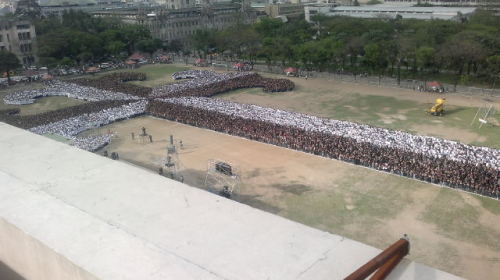
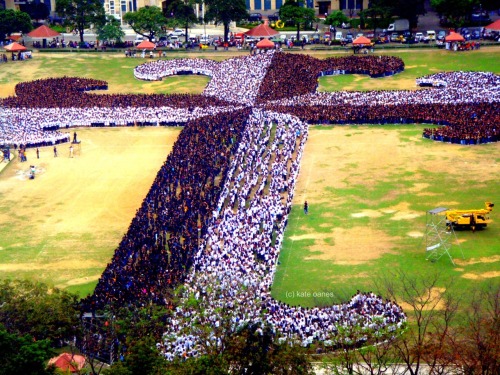
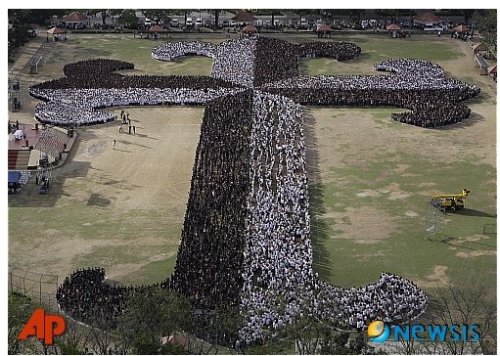
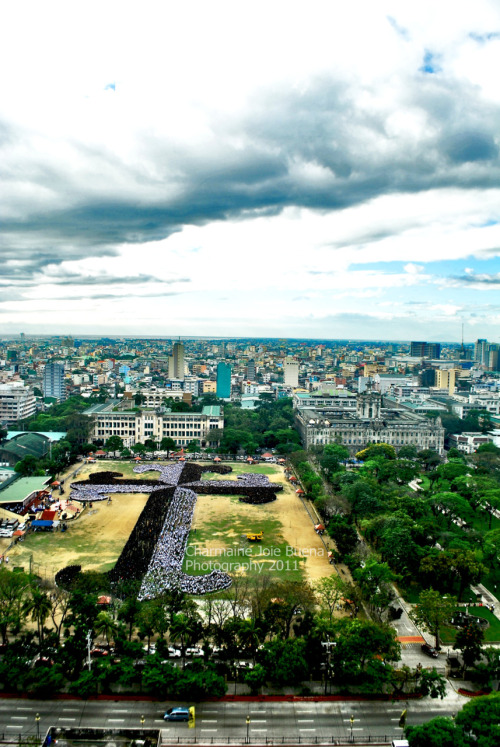
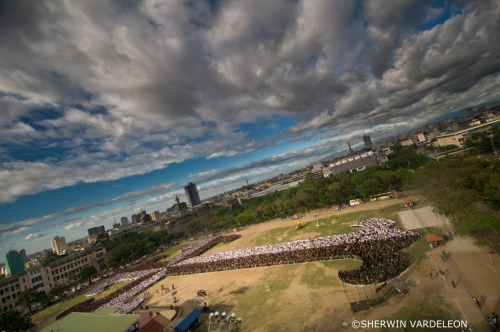
Everybody knows Ash Wednesday.... Yeah, the start of the Lenten Season. But here in Manila, specifically in a 21.5 hectare patch of land called the University of Santo Tomas, it's more than having small ash crosses on every Thomasian's forehead. Let the pictures do the talking....


I suppose you saw these pictures online, and they are found HERE, HERE, HERE, HERE, HERE, and HERE. 

And check out other pics from a Thomasian Tumblr page.

You could also check out Fr. Nilo Lardizabal, O.P.'s Facebook album, where the last photo is credited.

The event started by around 2:30 in the afternoon, where the students started to enter the open field and started to take the shape of the Cross. When the outline was completed, Thomasians pitched in and filled the insides. From the air and top floors, it was way better than the QRosary even if it didn't have a dry run due to the bad weather. When the formation was complete, Rev. Fr. Winston Cabading, O.P., Vice-Rector for Religious Affairs, led the 15-minute prayer highlighted by the Oratio Imperata for the Respect of All Human Life, the tolling of the bells in front of the UST Chapel, and the UST Hymn. After the dispersion of the participants, the Ash Wednesday Mass was celebrated by the University's Rector, Rev. Fr. Rolando de la Rosa, O.P., among other Dominican Fathers. 

Well, I guess Guinness would be satisfied of this after a minor issue about the Human Rosary. Nevertheless, God would be glorified by this feat. This only means that UST remains loyal to Christ (the Cross) and His Church (the Dominican Cross, with the Dominican Order as one of the leading Catholic religious orders). Many may say that this is an absolute waste of time. Who cares? They won't even dare to counter this sign.... As it is said: In hoc Signo vinces--In this Sign, thou shalt triumph.

P.S.: Also check out a report published by The V about this....

Tuesday, November 9, 2010

Sacrilege! Shameful apathy!

(The following entry is the Editorial of the Oct. 29, 2010 issue of "The Varsitarian": The Official Student Publication of the University of Santo Tomas. The entry could also be viewed here.)


Last October 1, Intramuros tourist guide Carlos Celdran staged a shocking, stupid, and shameful stunt all in one when he disrupted Holy Mass at the Manila Cathedral, where Apostolic Nuncio Edward Joseph Adams and Archbishop Gaudencio Cardinal Rosales were present. Styling himself as the “new” Jose Rizal and dresssed in the national hero’s characteristic European attire, he broke up the solemn Mass and carried around a placard with the inscription “Damaso,” a reference to the friar-character in Rizal’s novels, and shouted at the bishops and clery on the altar, “Stop involving yourselves in politics!” He was referring to the Church’s opposition to the Reproductive Health bill, several versions of which have been refiled in the new Congress, as well as criticism of President Aquino’s statements during his US trip that he’s in favor of “responsible parenthood,” or some form of birth control.
Even if he clearly does not agree with the Church, Celdran could have just let his mind known by a letter to the editor: after all, the Church representatives only made known their stand when they were interviewed by the media. But arrogantly enough and without regard for religious sensibilities, Celdran did the brazen act of desecrating the Church, her priests and liturgy. As a result, he landed in jail for committing a crime against religious worship, a violation of Article 133 of the Revised Penal Code.
But what was more alarming was that many Catholics did not condemn Celdran’s “shameful deed,” as described by the Manila clergy.
Even more terrible was that at the time of Celdran’s detention, about 6,500 people, apparently Catholics, had immediately supported a Facebook fan page calling for his release. Moreover, feminists rallied in front of the building of the Church’s episcopal conference in Intramuros with obscene placards directed at the bishops such as, “Get your rosary out of my ovary.” Even harlots would not use such language!
In what planet are Celdran and his supporters living? Perhaps they should repeat their stunt in a Muslim mosque or an Iglesia ni Cristo service. Let’s see if they would not get lynched.
Celdran’s arrogance was not only an affront to religion; it was an insult to the national hero. Even if Rizal was a Mason, a liberal secularist, and an anti-cleric, he would not have disrupted the Holy Mass and cursed the clergy. In his distasteful, unseemly blog, Celdran styles himself and those opposed to the Church’s stand on population control as “the new Jose Rizal.” What megalomania! Even the diehard Rizalista would not make such a claim. Apparently Celdran and his ilk have been making the fantastic claim inside the Mandaluyong sanatorium.
The apathy of many Catholics to denounce Celdran’s outright assault of the Church is a reality check on the Church both as a hierarchy and as people of God: Catholics are woefully ignorant of the Church’s teachings. The Catholic Church and her leaders have failed to educate Catholics on the teachings of the Church.
This problem may also stem from the failure of schools, particularly Catholic schools, to impress upon the students the position of the Church on issues such as the RH bill, which goes against the Church’s teachings on the basic right to life.
Closer to home, has UST, which prides itself as the Catholic University of the Philippines and a Pontifical University no less, done its job in teaching the Church’s pro-life stand as it confronts issues such as population control?
In the University, a minimum 15 units of theology subjects are mandated. Despite this, a study of former Arts and Letters Dean Armando de Jesus last year revealed that many Thomasians are “religious but not moral”––a finding which implies the tendency of Thomasian students to support the RH bill.
To be sure, this disturbing situation in the academe should force the Institute of Religion, the office in charge of the theology subjects, to start rethinking its curriculum and method of instruction, particularly SCL3 (The Social Teachings of the Church) and SCL9 (Marriage and Family).
All of the subjects are treated in an abstract manner, without reference to pressing issues of the day. For example, the chapter on natural family planning in the Marriage and Family textbook does not really explain why there should be family planning at all, it does not explain the geopolitcal context that has forced couples more and more to limit their family size. The discussion does not reveal the population-control mindset that occasions the discourse on family planning, whether natural or contraceptive.
Moreover, the chapter does not explain really why natural family planning is best. It does not even make reference to the natural law that underpins the Church’s moral teachings.
Theology professors appear to be ignorant of the issues around the RH bill and population control, considering that these issues are pressing to young Thomasians who have impressionable minds. Corollarily, UST doctors and bioethicists have largely evaded the issues. Most UST doctors, who receive perks from drug companies some of which produce contraceptives, don’t even go out of the way and explain to the public the side effects and risks of chemical contraceptives.
The Church, her leaders and teachers should tell Catholics that alleged overpopulation is not the cause of the poverty in the country but corruption, mismanagement and poor public policy. As columnist Atty. Jose Sison, a loyal Thomasian, said, “overpopulation” is the wrong term to use for the congestion of Metro Manila and urban centers, which is a migration and development phenomenon. In any case, he said it is wrong to blame the poor people for their poverty: the corruption and mismanagement of public officials are the culprits.
World-class economists such as Simon Kuznets and Jacqueline Katzun have denied any negative correlation between population and economic growth. Meanwhile, Nobel-winning economists Amartya Sen and Gary Becker have recommended that funds for birth control would be better used in directly addressing poverty.
Moreover, the RH bill is draconian and violative of human rights. The version by Albay Rep. Edcel Lagman bill forces employers into providing contraceptives to workers under their collective bargaining agreements. How can UST, a Catholic institution, offer contraceptives to its employees?
Catholics should understand that natural family planning teaches husbands to respect their wives’ body cycles. It teaches trust, discipline and fortifies the family as an institution contrary to the RH bill, which advocates shortcuts, fosters irresponsibility, and weakens the family. Therefore, natural family planning humanizes us while artificial methods, which RH bill espouses, make us look like sex-starved rabbits.
House Bill 5043 carries a provision in which a spouse can get a vasectomy or ligation without the consent of the other spouse, which is tantamount to legalized treachery.
In addition, the bill also wants to muzzle the opposition by providing a provision that punishes those who allegedly spread “disinformation.” In addition, foreigners who speak against the bill may be deported. (What if the Pope visits the country and calls population-control measures anti-life? Can Lagman kick the Supreme Pontiff out of the country?)
Catholics are duty-bound to study the many anti-life and anti-human-right provisions of the RH bill and uphold with conviction the stand of the Church against it and other social-engineering measures of the state. Thomasians and other Catholics should rouse themselves from their apathy. Let the biblical injunction be their guide: “If you are neither hot nor cold, I will vomit you out of my mouth.”

Followers

Heads' Up!